
“Satisfaction lies in the effort, not in the attainment, full effort is full victory.”
- Mahatma Gandhi
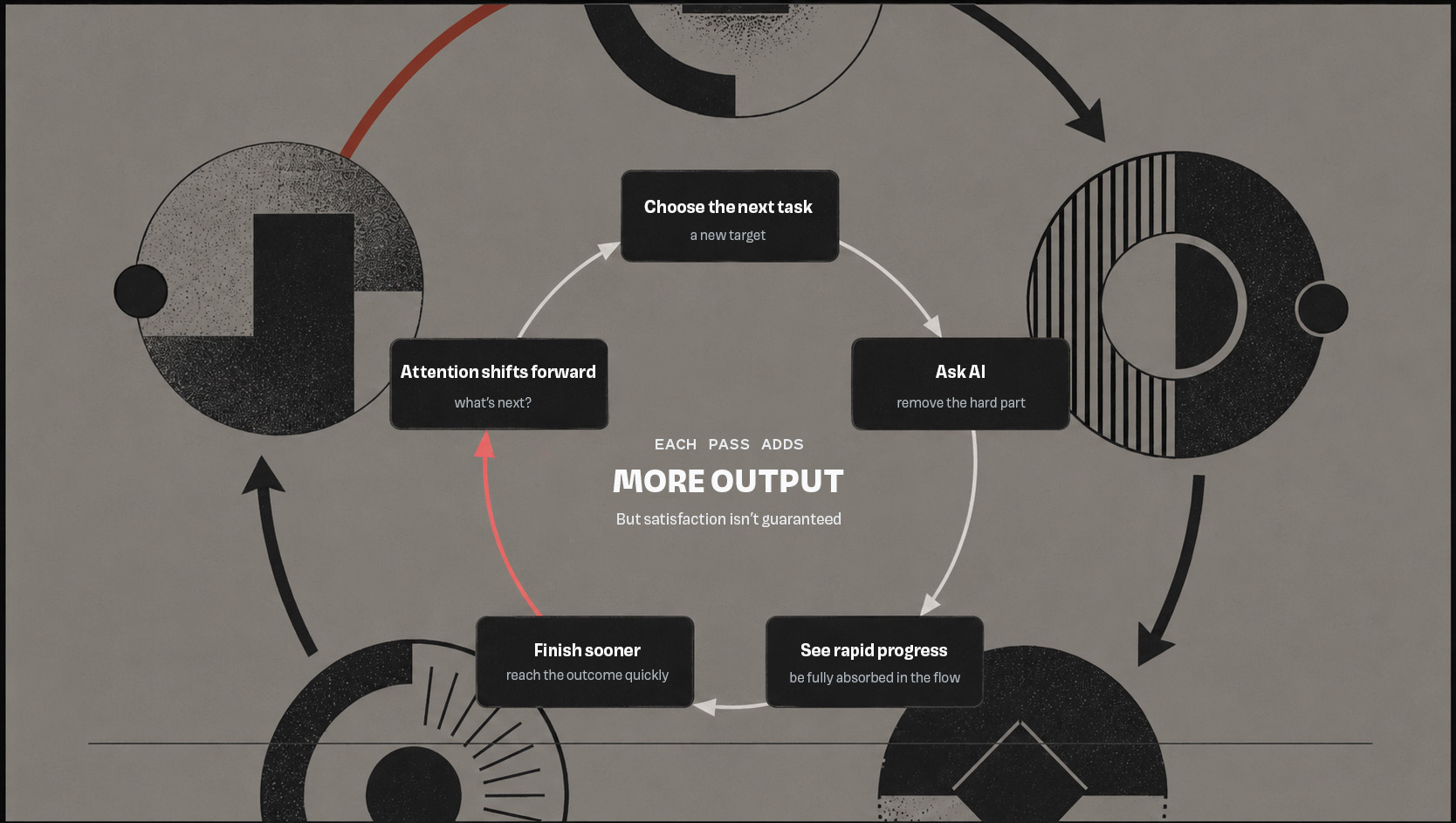
In 2026, AI moved well past vibe coding into shipping real, working software or content (e.g. imagery, videos, or copy) in a single sitting. I launched my own personal website within a matter of days without paying a third party to host it or knowing HTML, after years of wanting to build one out. You’d think accomplishing something you had on your list for years would produce a bigger emotional high, but instead I found myself wondering what I could build next.
Getting things done runs on dopamine, the brain's motivation molecule. Dopamine neurons send their axons to brain structures involved in goal-directed behavior (e.g. the striatum, nucleus accumbens, and frontal cortex) driving motivation, focus, novelty-seeking, and the energy to act (Schultz, 2016). Finishing something quickly, then reaching for the next thing, is exactly what keeps dopamine firing.
But the satisfaction we're actually chasing from accomplishing tasks or goals is a different reward system: serotonin. Serotonin pairs with dopamine to create the experience of pride or recognition, both from your own wins and the wins of people close to you or those you care for.
Individual pride is earned by effort (i.e. by doing something hard that you set out to do). AI removes the hard part, so you arrive at the outcome without the good lasting feeling that was supposed to come with it.
Dopamine is designed to point us forward. The moment you check something off, dopamine has already turned toward what's next. The molecule that gets you through your list is built to never call it a day.
Dopamine drives motivation, anticipation, and the reward-prediction that makes the next step feel worth taking. It was the first reward system to evolve, and its job is to keep you moving toward the next useful thing.
Optimization tools feed this beautifully. Each accepted change or generated draft is a small signal of progress that your brain reads as "good, keep going." That's the pull back to AI to accomplish another task again and again. The loop is simply our most ancient motivational circuit operating at a velocity it was never evolutionarily designed to handle.
The satisfaction you're often missing when you take shortcuts is pride, and pride has a specific recipe: serotonin and dopamine together. Dopamine supplies the drive, and serotonin adds the sense of earned status and self-worth.
Effort is what earns the status and self-worth. When people work harder for a reward, the effort amplifies the brain's reward response, an effect that's muted when the same reward comes easily (Hernandez-Lallement et al., 2013; Ma et al., 2014; Wang et al., 2017; reviewed in Inzlicht et al., 2018).
The harder you work for something, the bigger the payoff you feel. Long, difficult, and meaningful tasks and goals generate real pride. Easy wins barely register.
AI is remarkably good at removing difficulty, and when the hard part of a task disappears, most of the pride that was waiting on the other side of it disappears too. You get the deliverable and skip the earning.
Using AI to accomplish tasks is like buying a trophy before running the race. You own the object, but not the satisfaction. AI can hand you the trophy in minutes or hours. The race is still where the satisfaction lives.
The middle is where flow lives. Flow is the state of being fully absorbed in something that stretches you just enough: hard enough to hold your focus, but not so hard you stall. In Csikszentmihalyi and LeFevre's classic 1989 study, that balance of challenge and skill is what produced people's most energized, positive experiences in life.
The middle feels good because you're in it. Flow needs a healthy challenge to meet, but it can’t be too hard. AI reduces the hurdle for many tasks, making vibe coding a real vibe.
Also, we're wired to enjoy staying busy over being idle (even if the busyness is forced on us) (Hsee et. al, 2010). Moreover, in a productivity-obsessed culture, many of us measure our worth by output (Keinan et. al, 2011). We hate to be the bottleneck for productivity, so we feel better keeping things moving along.
Some of that feeling good in the middle is real flow, and some of it is just discomfort with stillness. And AI is very good at keeping us busy.
Emotional fitness is the practice of activating all your reward systems regularly and deliberately instead of letting just one (dopamine) run the show. Keep the effort where the pride matters: give AI the busywork, but save the hard, meaningful part for yourself – when the point is to feel proud of it.
Choose tasks or goals that genuinely excite you rather than ones you think you should want. Deci and Ryan's work on intrinsic motivation found that doing something for its own sake sustains us, while chasing the outcome alone tends to make the desire fade. Since you can control the process (and not the outcome), the process has to include some lasting feel-good chemistry, too. Enjoy the process, and let the small wins along the way each earn their own bit of serotonin.
Finally, don’t forget to record the accomplishments as they happen, since recalling a win reactivates the same feel-good neurotransmitters (FGN) that made it feel good the first time. When you finish an important step, stop long enough to register it before the next task pulls you off.
Matter helps you understand which of your six reward systems a moment actually lights up, and which experiences are worth your effort to enjoy. See which ones light up for you.